Resist the QR-codification of spaces of leisure
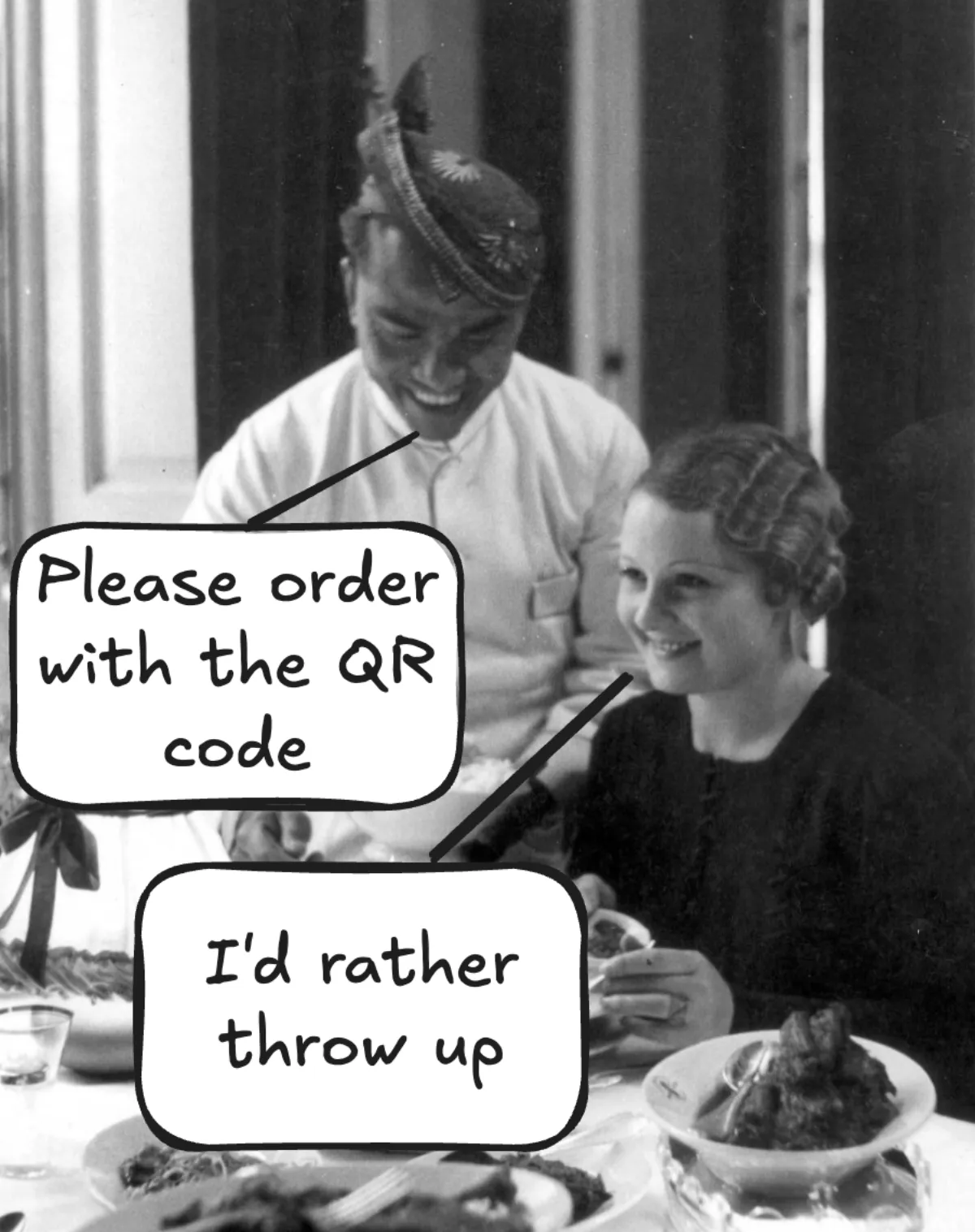

With enough time and boredom I hope to one day write a full treatise arguing for the CRIMINALISATION of QR codes in spaces of leisure, such as bars, cafés, pubs, cinemas and the like.
Alas, events have forced me to act. I will give a brief sketch:
On a hot summer day in our favourite lakeside brasserie, the only thing standing between my dad and a chicken caesar salad with two lemonades were 10 consecutive finger taps in a janky HTML form on a laggy 3G connection. After getting frustrated with his inability to bend the form to his will, he looked at me in quiet resignation and said: “Am I really getting that old?”.
No, dad, you are not getting that old. The indignity which you suffered on your day of leisure is due to a choice that we as a society have collectively made. That older people don’t protest vocally against the QR-codification of spaces of leisure is probably due to their fear of being judged for lacking “21st century skills”.
But what are these “skills” exactly, and why do I possess them whereas my dad does not?
The skills that I possess were picked up from video games, dodging ads on porn and illegal streaming sites, and avoiding sneaky surcharges on cheap airlines’ Kafkaesque websites. These “21st century skills”, craved by the old and abused by the young, are simply a coping strategy for surviving our vile little corner of late capitalism. In other words, there is nothing virtuous or admirable about my ability to bend janky HTML forms to my will. These so-called “skills” are nothing to be proud of, and not something we should encourage.
QR codes, while admired by software engineers for being fast and fault-tolerant (when they work), in practice just mean the replacement of a 10 second conversation with 10 taps on janky form. When used in places of leisure they represent a subtle perversion of the social contract. QR codes may be clever, but putting them in spaces of leisure is, to use a term familiar to software engineers, is an “anti pattern”.
Ditching the smartphone makes you a quiet but powerful ally against the QR-codification of spaces of leisure.